




Angry person in a quiet room
Concept
Angry expression
A facial expression in which anger is legible through tension in the brows, eyes, or mouth.
Compare ↗Concept / Teaching
An interaction in which one subject communicates knowledge, a skill, or a procedure to another and directs attention to a learning subject
An interaction in which one person communicates knowledge or a skill to another and directs attention to a learning subject.

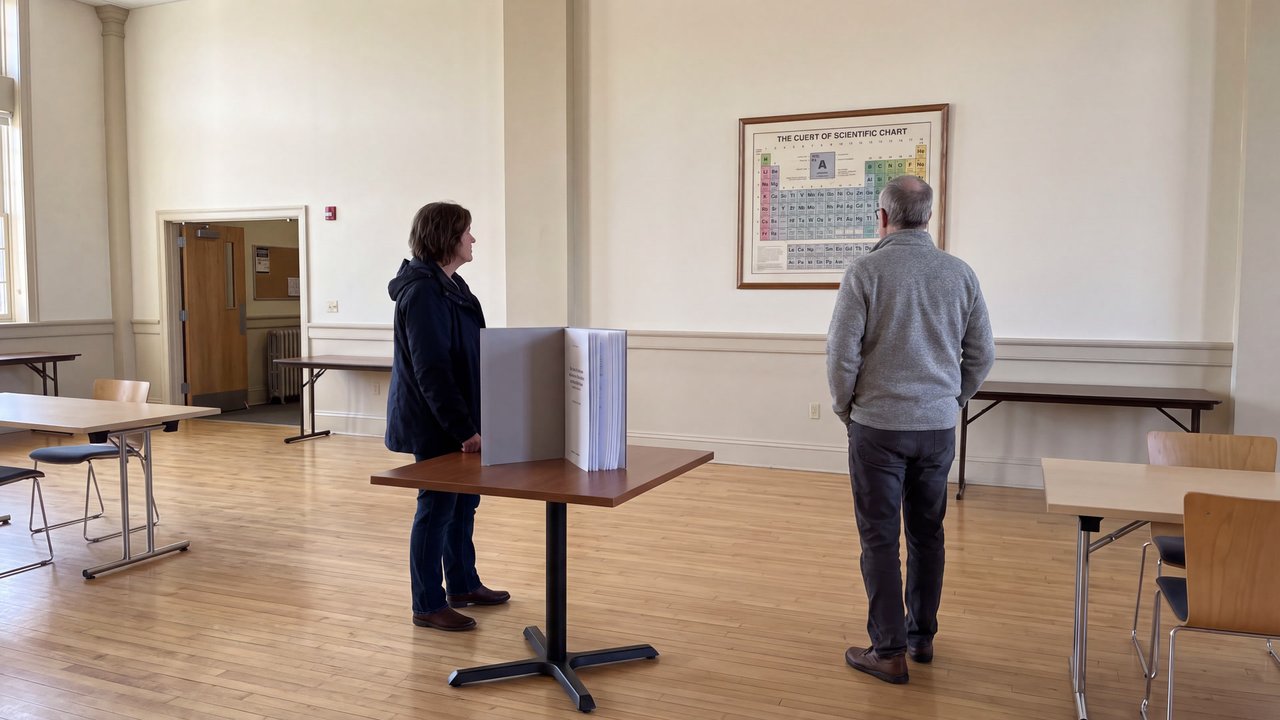
Two people standing separately beside an unattended booklet
The standard comparison motif cannot compare the relationship among a person communicating, a person learning, and a learning subject, so it is replaced with two people and neutral material that do not pre-stage explaining or attention.
Both languages share the English example images. Japanese prompts are the recorded translations.
Directs the image toward teaching in which one person guides another's learning.
One person directs attention to a learning subject while another engages with it as a learner.
The standard comparison motif cannot compare the relationship among a person communicating, a person learning, and a learning subject, so it is replaced with two people and neutral material that do not pre-stage explaining or attention.
two people standing separately beside a closed notebook in an open area, with neither attending to the notebook or the other person and with no explaining or directing
The standard comparison motif cannot compare the relationship among a person communicating, a person learning, and a learning subject, so it is replaced with two people and neutral material that do not pre-stage explaining or attention.
two people standing separately beside a plain card in a bright room, with neither attending to the card or the other person and with no explaining or directing
The standard comparison motif cannot compare the relationship among a person communicating, a person learning, and a learning subject, so it is replaced with two people and neutral material that do not pre-stage explaining or attention.
two people standing separately beside a simple diagram in an open area, with neither attending to the diagram or the other person and with no explaining or directing
The standard comparison motif cannot compare the relationship among a person communicating, a person learning, and a learning subject, so it is replaced with two people and neutral material that do not pre-stage explaining or attention.
two people standing separately beside a closed booklet in a spacious quiet room, with neither attending to the booklet or the other person and with no explaining or directing
The standard comparison motif cannot compare the relationship among a person communicating, a person learning, and a learning subject, so it is replaced with two people and neutral material that do not pre-stage explaining or attention.
two people standing separately beside a blank sheet in a calm outdoor area, with neither attending to the sheet or the other person and with no explaining or directing
Teaching is an interaction in which one subject communicates knowledge, a skill, or a procedure to another and directs attention to a learning subject. It does not determine a school, professional teacher, age difference, hierarchy, assessment, success, or a particular culture or medium.
It concerns a relationship of guided attention among a person communicating, a person learning, and a learning subject. It is distinct from presentation alone, one-way instruction, and ordinary collaboration.
The kind of knowledge or skill, learning material, positions of the two people, and location can be adjusted separately.
Content updated:
Items linked through explicit membership in the same theme.
Angry person in a quiet room
Concept
A facial expression in which anger is legible through tension in the brows, eyes, or mouth.
Compare ↗
Arms-crossed person in a quiet room
Concept
A static bodily stance with both arms crossed before the chest.
Compare ↗
Person looking aside in a quiet room
Concept
A gaze directed away to the side rather than toward the frontal focus.
Compare ↗